
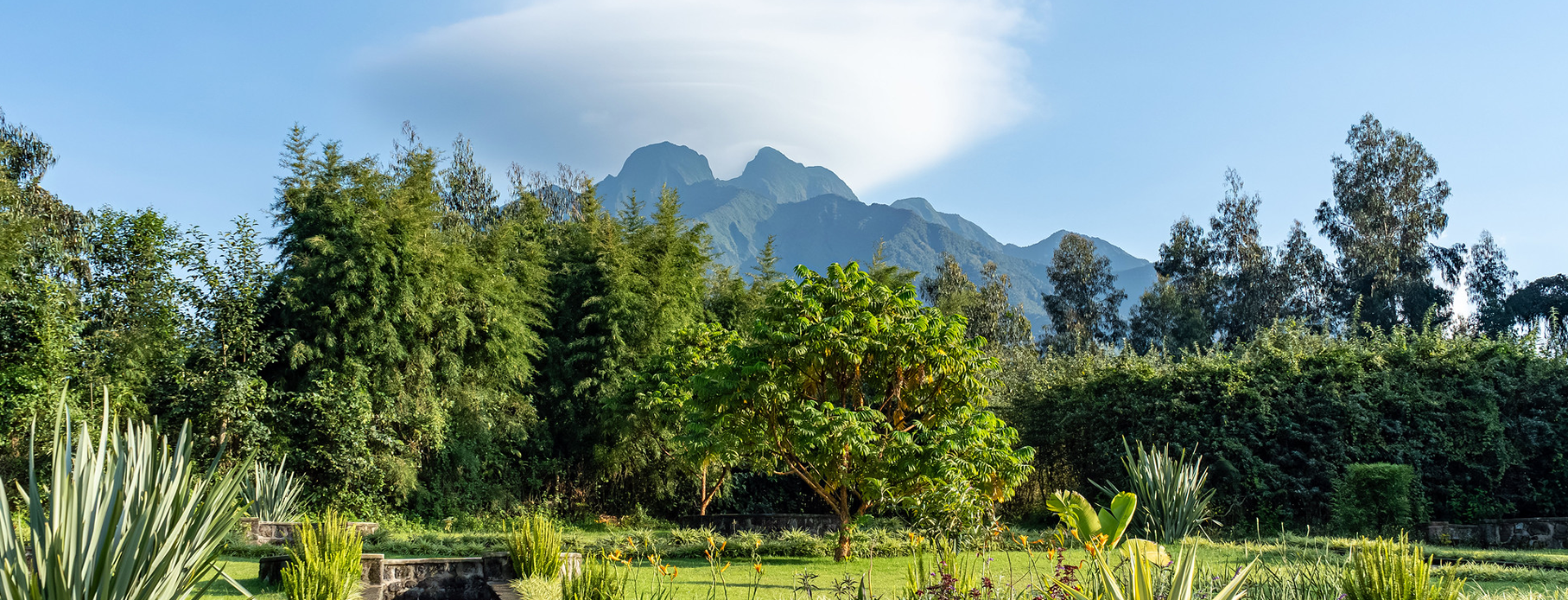
Golden Monkeys, Gorillas & Volcanoes
Rwanda’s ancient volcanic highlands hold creatures found nowhere else on Earth, and you don’t need a travel companion to find them.
The alarm goes off at 4:45 a.m., and the air in the banda is cold enough to make you question every decision that brought you here. Then you remember: today is gorilla day. You pull on your layers, lace up your boots and step outside, where the Virunga volcanoes cut a jagged line against a sky still thick with stars. The doubt vanishes. You are exactly where you’re meant to be.
Volcanoes National Park lies in Rwanda’s northwest corner, pressed against the borders of Uganda and the Democratic Republic of Congo. It protects a chain of volcanoes draped in montane forest, bamboo thickets and afroalpine moorland, a landscape so improbable it feels like Africa stacked on top of Scotland. For solo travellers who want real wilderness without the noise of a crowd, it is close to perfect.
Getting There and Choosing a Base
Musanze (formerly Ruhengeri) is the gateway town, around two hours by road from Kigali. The drive is half the pleasure: green hills roll past the window, with terraced farms stitched up every slope to the ridgeline. Buses and shared taxis leave regularly from Nyabugogo terminal in Kigali, but many solo travellers hire a private car or join a shuttle, since trek mornings demand flexibility.
Accommodation runs from budget guesthouses in Musanze town to mid-range lodges and luxury retreats near the park boundary. For logistics, the lodges around Kinigi, the community nearest park headquarters, are hard to beat. Many offer single rooms without a punishing supplement if you book directly, and the staff are used to independent travellers arriving with big packs and bigger questions.
Permits are non-negotiable and must be booked in advance through the Rwanda Development Board. At $1,500, the gorilla permit is the largest expense of the trip. It funds conservation directly, and that knowledge feels different when a silverback is ten metres away.
The Gorilla Trek
Briefings begin at park headquarters by 7 a.m. You’ll be assigned to one of the dozen-plus habituated gorilla families, based on your fitness and the trackers’ morning reports of where each group slept. Solo travellers often end up grouped with other independent adventurers, which makes for surprisingly good company on the trail.
The trek can last anywhere from thirty minutes to six hours, depending on where the gorillas have wandered. A lead guide clears the way with a machete while trackers radio ahead. You follow single file, ducking under hagenia branches, scrambling over roots and pushing through stinging nettles that even thick gloves can’t fully defeat. The forest smells of wet earth and wild garlic.
Then, without ceremony, the guide stops, raises a fist and whispers: “They are here.”
Nothing on wildlife television prepares you for it: the bulk of an adult silverback, the stillness of an infant clinging to its mother’s back, the unsettling intelligence in the eyes of a juvenile who has decided to stare back. It lands somewhere between awe and mild existential crisis. You get one hour with the family, and it passes in about four minutes.
Solo travelling gives you an edge here. You can move freely within the viewing area, crouch low and stay quiet, taking it in on your own terms without negotiating angles with a partner or waiting on someone else’s camera.
Golden Monkeys: The Trek That Flies Under the Radar
Many visitors come for the gorillas and leave never knowing that the park also protects a thriving population of golden monkeys, which can be trekked for a fraction of the gorilla permit price.
These animals are endemic to the Virunga Massif and live nowhere else on the planet. They move in large, boisterous troops through the lower bamboo zone, their burnt-orange and black coats almost too vivid to be real against the green. Where gorillas carry gravitas, golden monkeys carry chaos. They leap, squabble, chase each other through gaps in the canopy and occasionally drop bamboo shoots on your head.
The trek is shorter and gentler than the gorilla hike, which makes it ideal for pacing your itinerary or recovering from altitude. It is also, frankly, more fun: loud, frantic and full of laughter. For a solo traveller hoping to meet people, golden monkey morning is the park’s social event.
Birding the Volcanoes
The park sits within the Albertine Rift, one of Africa’s most important birding regions. Over 200 species have been recorded here, and many are Albertine Rift endemics found nowhere else.
You needn’t be a dedicated birder to enjoy them. On almost any trek, you may spot Rwenzori turacos flashing crimson wing panels between the branches, Handsome Francolins rustling through the undergrowth and regal sunbirds glittering at the forest edge. Archer’s ground robin skulks in the dense understorey, rewarding patient listeners.
If birding is your main interest, specialist guides can be arranged through operators in Musanze. A dawn walk along the forest edge, before the trekking groups set off, is the quietest and most productive window.
Going Higher: Hiking the Volcanoes
The volcanoes are more than a backdrop. Several are open to hikers, each offering a different experience.
Bisoke (3,711m) is the most accessible full-day summit hike. It climbs through wildlife-rich forest zones to the rim of a beautiful crater lake, and on a clear morning the view into the DRC is extraordinary.
Karisimbi (4,507m), the highest of the Virungas, is a two-day climb with a night’s camping below the summit. It is cold, demanding and spectacular, and for a solo traveller comfortable with altitude it offers a solitude that feels earned.
Sabyinyo is a ridge scramble along the meeting point of Rwanda, Uganda and the DRC, where you can stand in three countries at once. It has an obvious appeal to the solo-travel mindset.
All volcano hikes must be arranged through the park office and require a guide. Permits cost far less than primate treks and can often be booked a day or two ahead.
Practical Notes for Solo Travellers
- When to go: The dry seasons, June to September and December to January, offer the easiest trekking, though the park is open year-round. The rains bring lush forest, lower lodge prices and fewer crowds, but muddier trails.
- Altitude: The park rises from about 2,400m to over 4,500m. Spend a day acclimatising in Musanze before anything strenuous.
- What to pack: Layers, since mornings are cold, midday can be warm, and the forest is always wet. Waterproof trousers, gaiters and long gloves for the nettles are essential, and broken-in boots matter more than almost anything else.
- Safety: The park is very well managed, with experienced guides and trackers on every outing. Beyond normal wilderness awareness, solo travellers face no particular concerns.
- Budget: Beyond the gorilla permit, a guesthouse room, meals and local transport in Musanze can run $40–70 a day. Golden monkey permits were listed at $100 and volcano hikes at $75–100 per peak.
The Morning You Leave
You’ll pack your bag in the dark again, just as you unpacked it. The volcanoes will fill the window: Karisimbi under its habitual cap of cloud, Bisoke’s clean cone catching first light. You’ll think about the silverback who looked through you as if you were made of glass, the golden monkey that landed three feet from your face and blinked, the turaco’s crimson flash.
Solo travel pays out in moments of unmediated encounter, and Volcanoes National Park offers them in abundance: not one headline species but a whole layered world of creatures, landscapes and improbable mornings that belong entirely to you.
Permits and trek bookings are managed by the Rwanda Development Board. Most Kigali-based tour operators can handle logistics for independent travellers.